Department of Information Systems, University of Haifa.
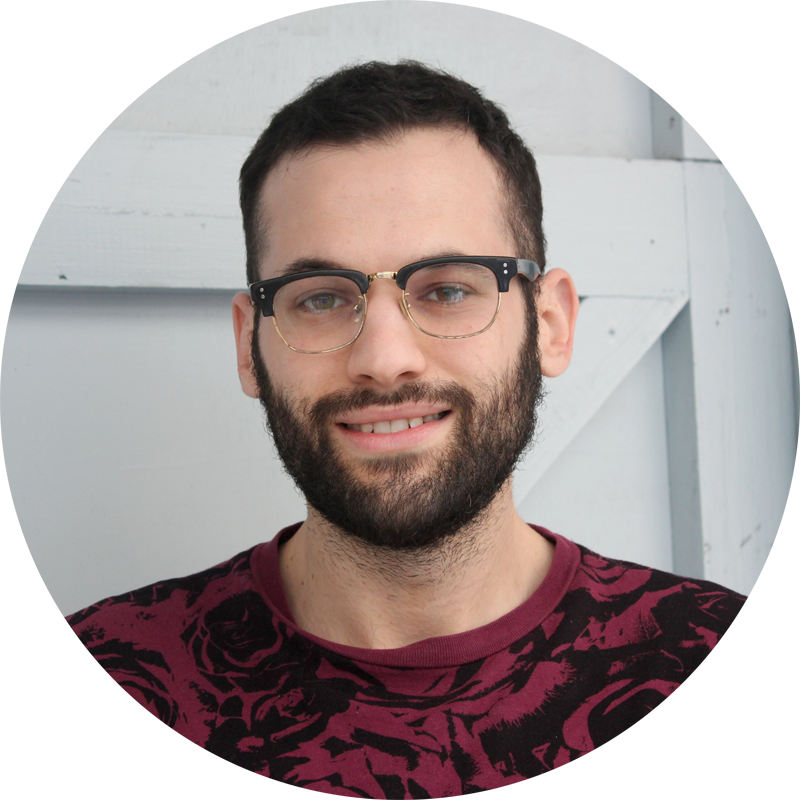
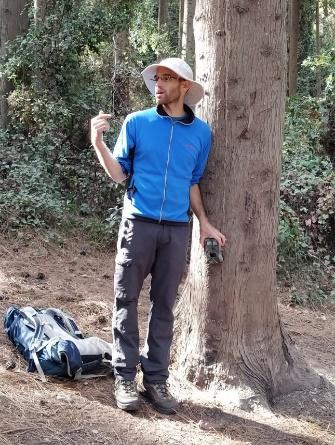
Ofer Arazy is a Professor of Information Systems, and his research is in the area of social computing, human computation, and human judgement. At the University of Haifa, Ofer’s roles include the Director of Innovation & Sustainability and the Head of Haifa Innovation Labs (HIL). Prof. Arazy is also co-founder of Israel’s iNaturalist node and the Chair of the Scientific Committee for Israel’s Citizen Science Initiative.
Department of Information Systems, University of Haifa.
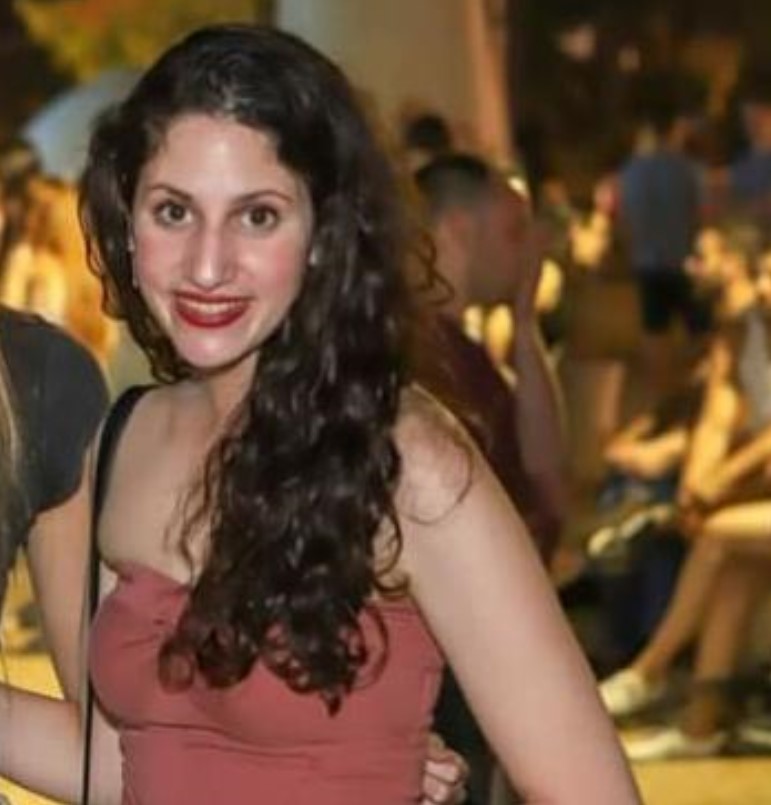
Ofer Arazy is a Professor of Information Systems, and his research is in the area of social computing, human computation, and human judgement. At the University of Haifa, Ofer’s roles include the Director of Innovation & Sustainability and the Head of Haifa Innovation Labs (HIL). Prof. Arazy is also co-founder of Israel’s iNaturalist node and the Chair of the Scientific Committee for Israel’s Citizen Science Initiative.
Department of Geography and Environmental Studies, University of Haifa.
Prof. Dan Malkinson is a Professor of Geography and Environmental Studies at the University of Haifa. He serves as the Director of the Kadas Green Roof Ecology Center and leads the ecology and environment research section at the Shamir Research Institute. Additionally, he co-chairs the International Geographical Union’s commission on Research Methods in Geography. Prof. Malkinson is also a co-founder of Israel’s iNaturalist node and a member of the Scientific Committee for Israel’s Citizen Science Initiative.
Yuval Nov is a faculty member in the School of Public health at the University of Haifa. His main research interests are biostatistics and stochastic methods in biotechnology. Yuval is a council member of the Israel Statistics Association (ISA), an editorial board member of the journal Scientific Reports, and the former head of the Data Science B.Sc. program at the University of Haifa.
Department of Information Systems, University of Haifa
Ilan Shimshoni is a Professor of Information Systems. His research areas are computer vision, computer graphics and robotics. In recent years he has also been developing algorithms in CV for solving problems in Archeology, Rehabilitation, Geography, and especially ecology and agriculture. He served as the chair of the IS department and was an Associate Editor for IEEE TPAMI, the leading journal in the field of computer vision.
Dr. Yiftach Nagar is an assistant professor at the Academic College of Tel Aviv-Yaffo, who explores novel ways of combining and organizing the work of AI, crowds and experts, for addressing complex problems. Trained in engineering, information systems research, social science and management, his work is interdisciplinary by nature. Yiftach earned his PhD from MIT, where he worked on the Climate Colab – a global citizen-science platform that aims to harness the collective intelligence of people around the world for addressing climate change and other societal challenges.
Perceptions and Preferences in Nature Monitoring: a VR Experiment. M.A. supervised by Ofer Arazy,.
Lior Koren
Videos of wild boars: detection’ , tracking’ pose estimation gender classification and reidntification. Department of Information Systems, University of Haifa. M.A. supervised by Ilan Shimshoni.
Ori Shapira
Species and individual identification of predator species. Department of Geography and Environmental Studies, University of Haifa. PhD. supervised by Dan Malkinson.
Weaam Shaheen
An integrated system of artificial intelligence and citizen science for tagging animal images. Department of Information Systems, University of Haifa. M.A. supervised by Yiftach Nagar and Ofer Arazy.
Tal Saphar Automated identification of individual salamanders from images. Department of Information Systems, University of Haifa. M.A. supervised by Ilan Shimshoni.
Lihi Cohen
Could a game simulation help to determine user’s preference? Department of Information Systems, University of Haifa. M.A. supervised by Dan Malkinson and Ofer Arazy.
Maria Nitsberg
Empirical validation of statistical model for bias-correction in unstructured citizen science biodiversity monitoring. Department of Information Systems, University of Haifa. M.A. supervised by Dan Malkinson and Ofer Arazy.
Bar Lavi
Database developer and administrator.
Achiad Davidson
Leading the project for empirical verification in the field to correct bias in biodiversity monitoring in citizen science projects.
Nitsan Bar-Shmuel
Project manager and community leader of the wild mushroom monitoring project in Israel.
Taking Citizen Science to School center by the University of Haifa and Israel’s Institute of Technology.
Israel Citizen Science Center at the Steinhardt Museum of Natural History on public engagement programs.
HaMaarag, Israel’s National Nature Assessment Program, operating under the auspices of the Israel Academy of Sciences and Humanities.
The Israel Nature and Parks Authority is a government organization that manages nature reserves and national parks in Israel.
iNaturalist, the world’s largest network of nature monitoring communities
Wild Me, Nonprofit organization that develops AI tools for collaborative, international wildlife conservation.
The Human Computation Institute, a nonprofit innovation center dedicated to the betterment of society through novel methods leveraging the complementary strengths of networked humans and machines.
Research
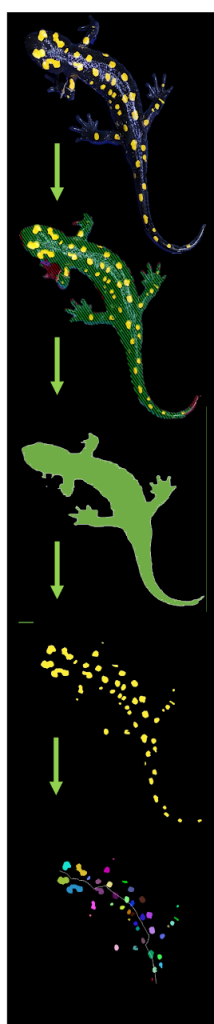
Automated identification of individual salamanders from images
Tal Saphari, Ilan Shimshoni
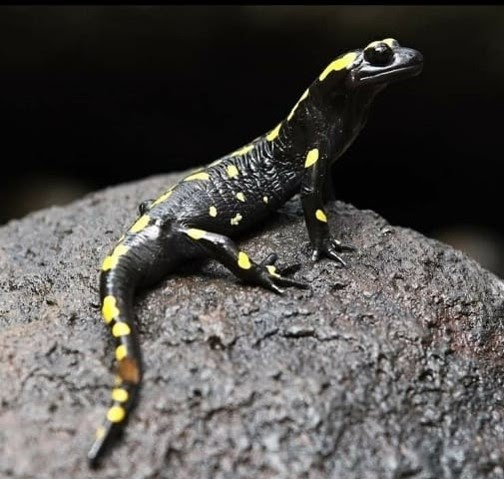
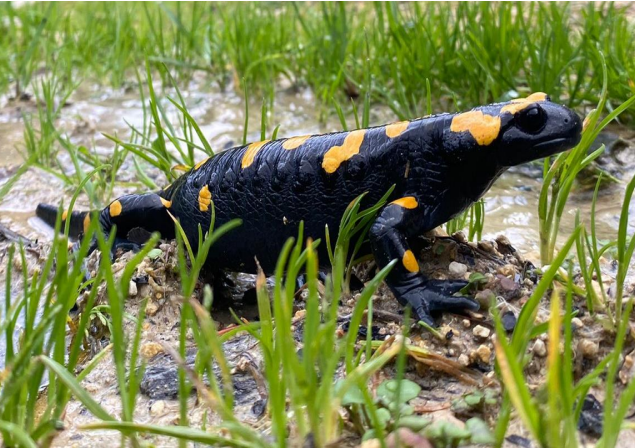
The Salamandra infraimmaculata, commonly known as the Near Eastern fire salamander, has been assigned the conservation status of “Near Threatened” on the IUCN Red List of Threatened Species. The Society for the Protection of Nature in Israel, in collaboration with Yarok Balev NGO, works to track Salamander population size by identifying individual salamanders by human experts based on digital images collected during annual winter monitoring projects. While this process is currently being done manually, we propose the development of an automated algorithm to process the images so that the identification of individual salamanders can take place without human intervention.
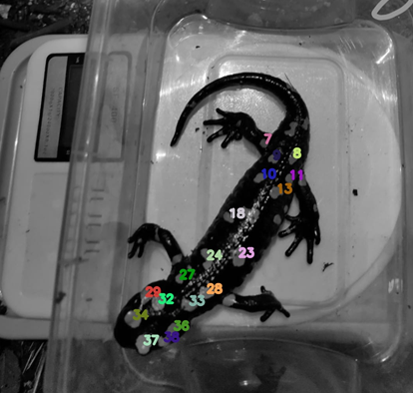
The main idea behind our approach is to treat the spot pattern on the salamanders as a type of identifying fingerprint. To implement our algorithm, we developed a multi-step process that involves several fundamental procedures. Initially, we perform image segmentation, which enables us to identify the salamander and its unique spots.
We generate a straightened image of the salamander using SVD and the Dijkstra algorithm to transform the pixels of the salamander, preserving the distance of each pixel from the head of the salamander and its skeleton. Then spatial and geometric features from the salamander’s spots are gathered, including size, shape, and center position and we construct a function to estimate the location of matching spots based on geometric features. We then used a neural network to determine the level of match between spots from different images. To do this we used a triplet loss function, training the net with examples of matching spots of the same salamander and non matching spots. Finally we use the output of the neural network to establish whether the salamander is the same or different according to how well the spot pattern fits previous images of salamanders.
Data curation- Image Classification AI&ML
Bar Lavi
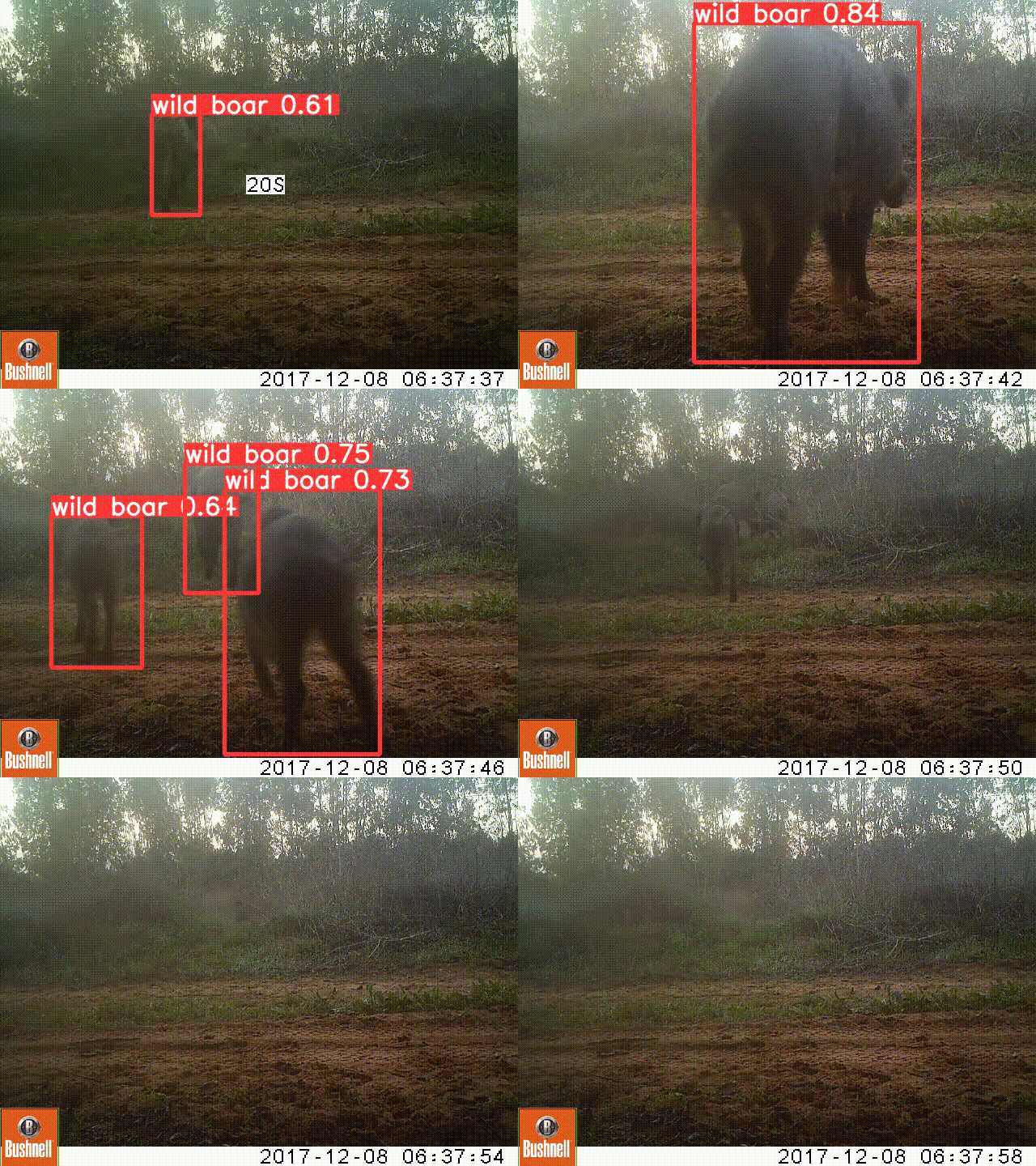
Tagging animals from images and videos using a trained AI. We re-trained the head of the trained neural network yolov5 using transfer learning and fine-tuning techniques in order to classify a set of animals including: (i) Sus scrofa (wild boar), Gazella gazella gazelle (mountain gazelle), Vulpes vulpes (fox), Canis aureus (jackal), Felis catus (cat), Mellivora capensis (badger), and Hyaena hyaena (hyena). In order to automate the classification process, we created a pipeline that utilizes mega-detector (MD). In addition, we trained machine to classify non-empty images and exclude empty images . The pipeline can also be applied to videos by extracting frames using OpenCV , removing empty frames (MD) and classifying animals in the remaining (non-empty) frames (yolov5) .
Currently, we are working to expand the classification range of animals while refining the existing classification. Additional data is being collected to improve the machine’s training, and to enhance the training process, algorithms are being developed using OpenCV to filter only significant frames from videos such as those depicting animal movement, entry, or exit. Moreover, we are adjusting different machines to accommodate various environmental scenarios and extending the range of animals on which the machine works.
Exploring biodiversity Biases using VR gaming
Lihi Cohen, Ofer Arazy and Dan Malkinson
Crowdsourcing is an innovative way for collecting wildlife data for biodiversity assessment. However, it comes with potential biases due to natural human tendencies. The aim of this study is to investigate the impact of such biases on the process of animal documentation For the purpose of creating a model that will allow us to normalize the collected data and use it .Methods: A 360 video of the Golan Heights was recorded, and a VR game will be created using the Unity gaming platform. Participants will be asked to observe and record sightings of animals that can be found in the area using VR glasses (Meta Quest 2) and VR controllers. Participants will be allowed to choose the animals they observe and record. Data will be collected across a range of animal species. We hope that by including observer experience we could potentially learn human recording preferences and if personal biases related to the animal’s behavior, traits or familiarity.
Participants are expected to record animals that are more visible or active, or that they find more interesting or appealing. They are also expected to overlook certain animal species or behaviors that they are less familiar with or that do not fit their preconceived notions. VR gaming offers a valuable tool for investigating such biases in a controlled and standardized environment and could potential help improve the quality and reliability of crowdsourced data.
Fine-grained classification for Individual animal ID
Lior Koren and Ilan Shimshoni
Advancements in digital photography negate the need for the physical capture of animals during population surveys. from 2017 outlines transforming Mark-recapture into Sight-Resight with the goal of animal population census. Sight-resight requires individual identification of the animals photographed. In species of unmarked featureless animals ID can be achieved by noting the sex and age of the animal photographed, thus reducing the search space for matches. This process can be a labor-intensive task.
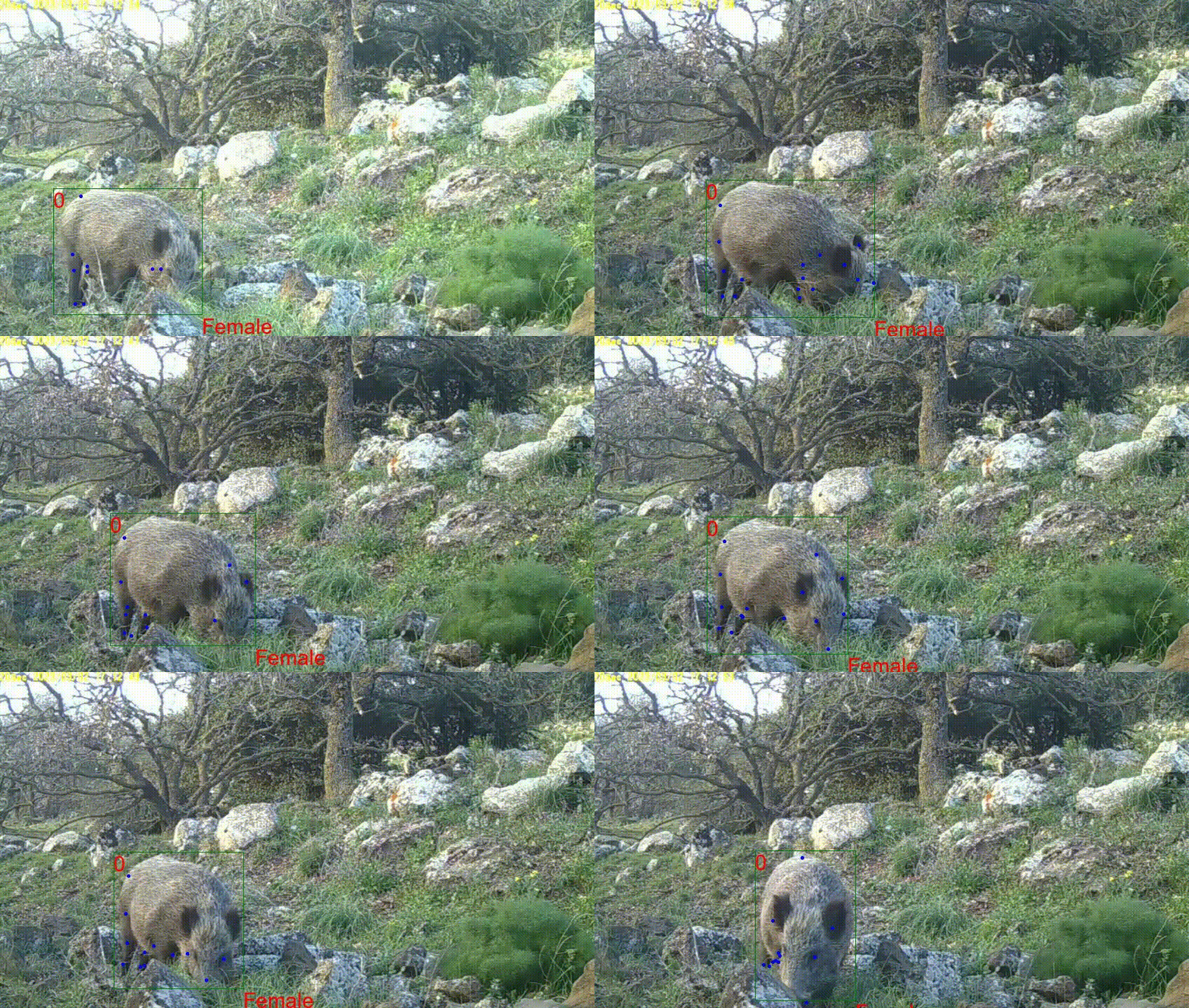
We propose a method for identifying the sex and gender using fine-grained classifying neural network. Using tracking and pose estimation models we tracked several individual boars in videos collected by Haifa University geography department and annotated the tracks by domain experts. Using images cropped from video frames we trained a fine-grained classification model. This model utilizes attention models to compare and contrast features from different classes, and enables differentiating between visually similar classes. We classified tracks in videos and compared the results to data collected by domain experts. We chose videos from Haifa area to train the fine-grained classification models, to separate them from videos collected in other areas, to avoid bias.
The validation set consisted of 513 images cropped from 12 videos of adult males, females and piglets collected in open areas around Israel. The validation image set results were extremely positive with over 95% accuracy differentiating piglets and adult boars. The male/female classification were slightly worse off at 89.3% accuracy. As our full dataset consists of videos, we are expanding testing to videos that are not fully annotated, and plan on classifying full video tracks by using majority rule on track frames. This allows us to enumerate boar types in videos and compare results to the data gathered by domain experts.
Publications
Keran Kaplan Mintz,Ofer Arazy and Dan Malkinson. (2022). Multiple forms of engagement and motivation in ecological citizen science. Environmental Education Research, 1-18. https://www.tandfonline.com/doi/abs/10.1080/13504622.2022.2120186?needAccess=true&journalCode=ceer20 In special thanks to “Tatzpiteva” community. Ofer Arazy and Dan Malkinson. (2021). A Framework of Observer-Based Biases in Citizen Science Biodiversity Monitoring: Semi-Structuring Unstructured Biodiversity Monitoring Protocols, Frontiers in Ecology and Evolution. doi: 10.3389/fevo. 2021.693602 https://drive.google.com/file/d/1gqga0NWWOkTjbAE04p2kwaSyzyI-D4SP/view Conferences presentation Dan Malkinson. Smart phones and stupid data. Is it possible to estimate wild mushrooms population with citizen science tools? Israel Wild Mushroom Conference. January 2022, Rahovot, Isreal. Yuval Nov . A Novel Method for Using Citizen Science Data in Biodiversity Monitoring. The 50th Annual Conference of Ecology and Environmental Sciences July 2022, Tel Aviv, Israel Tomer Gueta, Ofer Arazy, Dan Malkinson Nirit Lavia-Alon, Ariel Shamir, Shlomo Priceblum, Naama Arkin, Alon Sepan and Tamar Dayan. Public participation in biodiversity monitoring and research. The annual conference for ecology and environment. The 50th Annual Conference of Ecology and Environmental Sciences. July 2022, Tel Aviv, Israel